Pilgrimage of a Hajjanaut
new commission presented part of We Are Eagles, TarraWarra Biennial, TarraWarra Museum of Art
three channel film installation + directional sound; 19:30 minutes, engraved copper plate unique prints + graphite, hand engraved and pierced copper navigation sculptures
film and sound composition : Spencer Reid
‘The project Pilgrimage of a Hajjanaut is an embodiment of faith and science, one that generates decolonial images of heritage practice with which to speculate possibilities for past, present and future space migration. The Hajjanaut is a character of speculative fiction through which the lived experiences of a Muslim woman in space, offers a futurism of equitable space travel. The Hajjanaut does not currently exist in the literature around extraterrestrial travel or ‘off earth’ existence. I have proposed the term to specifically represent one, in this case a woman who undertakes the Hajj while living in space. The Hajjanaut was created from months of researching ninth to sixteenth century astronomical and celestial navigation instruments within the Arabic sciences, and their relation to migration and pilgrimage.
I have recently undertaken a pilgrimage which was, for myself a Hajj, both actual and performative; a journey, in which I negotiated for the first time my own experience as a migrant and pilgrim, to a point on the continent closest to Mecca in present time, and, as the Hajjanaut, a character of speculative fiction. I navigated a route from Otepoti Dunedin on Te Waipounamu Aotearoa, New Zealand in the South Pacific Ocean to Karajarri Country, Western Australia on the Indian Ocean during the Hajj in the month of June, a total of 5364 nautical miles. Archival research of astronomical manuscripts and celestial instruments of Islamic science and astronomy informed the crafting of celestial navigation instruments and celestial map making techniques for the pilgrimage. I established site specific records of the southern celestial hemisphere, and engaged with specific stars and constellations to identify latitudinal and longitudinal calculations for geographical locations along the pilgrimage route of Hajj.
To reimagine history and our common heritage requires the creativity of speculative fiction, as the weight of centuries of Eurocentric influence is a heavy burden. To draw from existing cultural heritage and practice and to look towards tomorrow’s science and technology is a central component of reimagining. It points to the importance of heritage in a local sense, and the politics of a universal global heritage. I feel that establishing a distinctly Islamic heritage practice founded in science and embodied through the experiences of the female character of the Hajjanaut offers a strong counter-narrative for western, patriarchal space colonisation. Within my project connecting to and reviving cultural heritage practice provides a foundation for the creation of Islamic speculative fiction which disrupts linear, colonising timelines, creating space for future imaginings.’
- Shireen Taweel.


Images taken by Andrew Curtis
This project has been assisted by the Australian Government through Creative Australia, its principal arts investment and advisory body
Between Science and the Sublime
Jessica Silverman Gallery, San Francisco
“Shireen Taweel: Between Science and the Sublime” reimagines the tools of science and navigation as instruments of orientation and possibility. Through a decolonial and feminist lens, Taweel expands the realms of science fiction and coppersmithing to chart new horizons of connection and understanding.
The exhibition features six new engraved copper sculptures and aquatint works on paper that envision migration beyond Earth. In her first show at the gallery and in the United States, Taweel draws on traditional forms of celestial navigation, bridging past and future, the earthly and the cosmic, the scientific and the spiritual. Through delicate sculptures of astronomical instruments and fantastical landscapes, the artist molds a world in which a plurality of beings flourish and actively participate in charting their own paths.
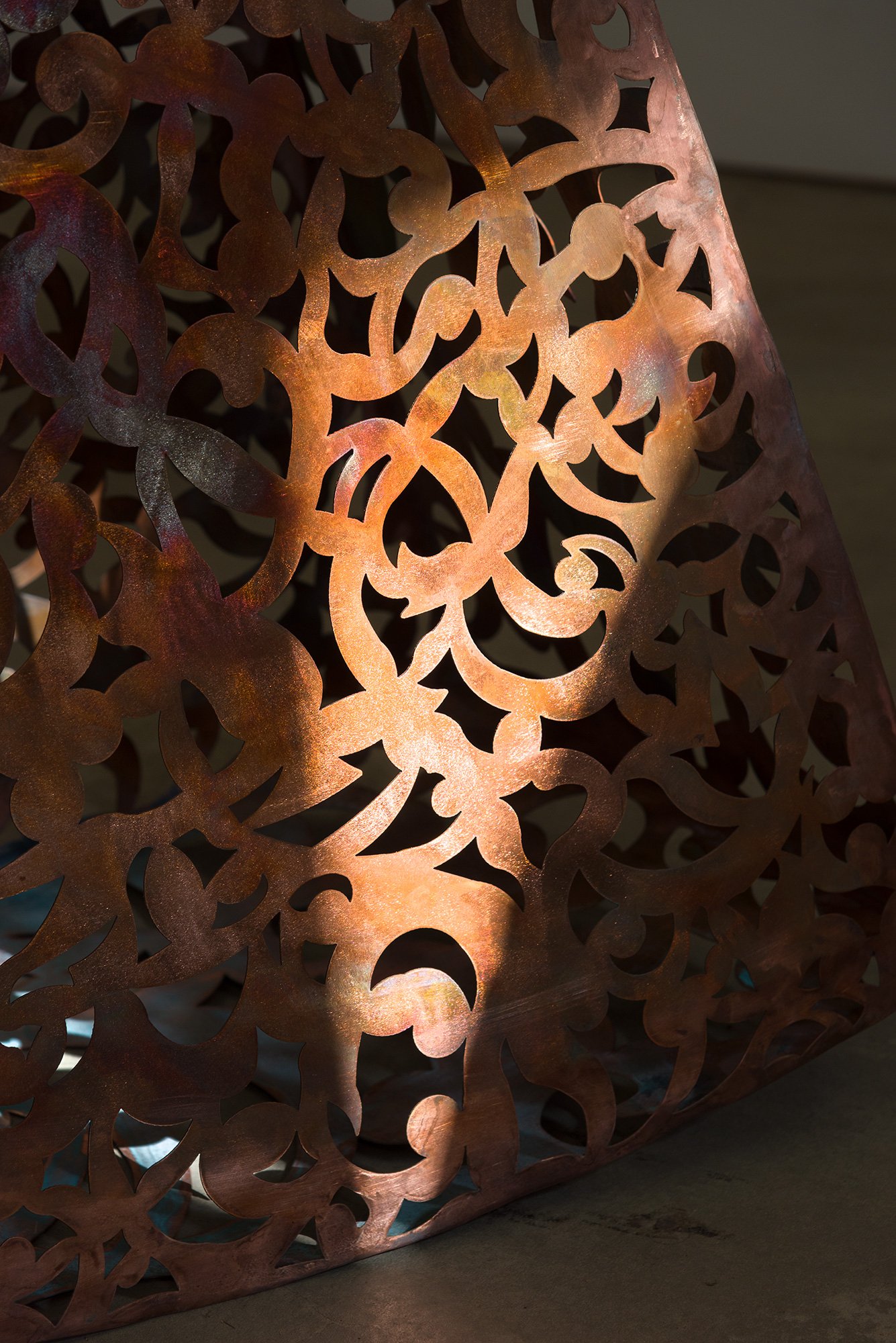
Light punctures pierced geometries in Taweel’s hand-built sculptures, which take the shape of speculative instruments for wayfinding. In Unknown Arcs of a Sphere II (2025) a crescent form balances atop a cone, decorated with intricate engravings and latticed patterns. Six unique designs take inspiration from historic astronomical tools, such as the qibla compass, astrolabe and sextant, and their scale directly corresponds to how people have used such devices to navigate land and sea. In this series of copper sculptures, titled Unknown Arcs of a Sphere I–VI (all 2025) after mathematician Al-Jayyani’s foundational 11th-century treatise on spherical trigonometry, Taweel unites technology, craft, and spirituality into instruments for imagining existence amongst the stars.
A purple-hued triptych titled Astro Architecture (2025) zooms out to reveal angular, sextant- shaped monuments scattered across a rocky terrain. The careful linework of Taweel’s copper engraving extends across both series, linking the languages of printmaking and sculpture.
Also on view, a suite of six cinnabar-colored unique prints, titled The Sun’s Down I–VI (all 2025), evoke the atmospheric glow of distant worlds. Each work is created through the meticulous process of hand-engraving copper plates and printing them using aquatint, resulting in soft, dreamlike depictions of undulating mountain ranges beneath celestial spheres. In these imagined landscapes, colossal astronomical instruments rise like architectural symbols of pilgrimage or structures for orientation and gathering. Their elliptical compositions suggest telescopic gazing that hovers between the scientific and the sublime.


Sacred Architecture and the Celestial Body
new commissioned work for solo Edge of the C, Penrith Art Gallery, NSW
pierced copper, silver solder - installation view

images taken by Garry Trinh
© Shireen Taweel 2026